We should all be deeply skeptical about anyone promising to create a perfect city or society. A lot has been written about how it is not desirable, or even possible, to create a “Utopia,” where everyone lives in harmony. Erik Olin Wright, the prominent sociologist, extensively discussed the concept of “real utopias” in his influential book Envisioning Real Utopias, where he outlines the potential dangers of idealism over practicality. Real Utopias dismisses the idea of perfect societies and instead advocates for practical, achievable alternatives rooted in existing social practices. His work serves both as a critique of capitalism and as a guide for envisioning a more equitable future. [Envisioning Real Utopias]
The word Utopia literally translates as “no place”, coming from the Greek: οὐ (“not”) and τόπος (“place”), and refers to any non-existent society. So it makes sense to look at Utopias as inspirational ideas and principles and not some perfect city or society that we are trying to create. A Utopia can therefore be seen as a set of ideas, principles, and goals aimed at improving people’s quality of life, without expecting perfection—this is the essence of SolarPunk.

When it comes to applying the right principles and goals, Gelephu Mindfulness City, a new city being built in the Kingdom of Bhutan, has a lot of good ideas. Gelephu Mindfulness City, announced in December 2023 by Bhutan’s King, is a 2,500 km² Special Administrative Region designed to integrate Gross National Happiness (GNH) principles with sustainable urban planning. The project aims to house over one million residents across eco-friendly infrastructure and diverse economic clusters, and is being built on these six principles.
1. Mindfulness and Well-being at the Core
At its heart, GMC is designed to cultivate mindfulness—an awareness of the present moment, both individually and collectively. This principle extends beyond meditation or spiritual practices into urban planning, community design, and daily life. Public spaces and neighbourhoods are created to encourage social interaction, reflection, and connection to nature, supporting mental and emotional well-being.
2. Integration of Tradition and Modernity
Rather than replicating a generic modern city, GMC is deeply rooted in Bhutanese culture, spirituality, and values. The city’s design is inspired by the sacred Mandala geometry, symbolising harmony and balance. This approach ensures that while embracing innovation and technology, the city preserves and honors Bhutan’s rich Buddhist heritage and cultural identity.
3. Environmental Sustainability
Gelephu Mindfulness City places ecological stewardship at the forefront. It aims to be carbon-neutral by leveraging renewable energy sources such as hydropower and incorporating green building materials like bamboo and timber. The city integrates natural landscapes, including paddy fields and river corridors, which act as biodiversity sanctuaries and natural stormwater management systems.
4. Economic Diversity and Resilience
The city is planned to foster seven economic clusters, including spirituality, health and wellness, education, green technology, finance, agriculture, and aviation. This diversification promotes economic stability, job creation, and innovation, supporting Bhutan’s broader development goals while attracting international investment.
5. Community-Centered Urban Design
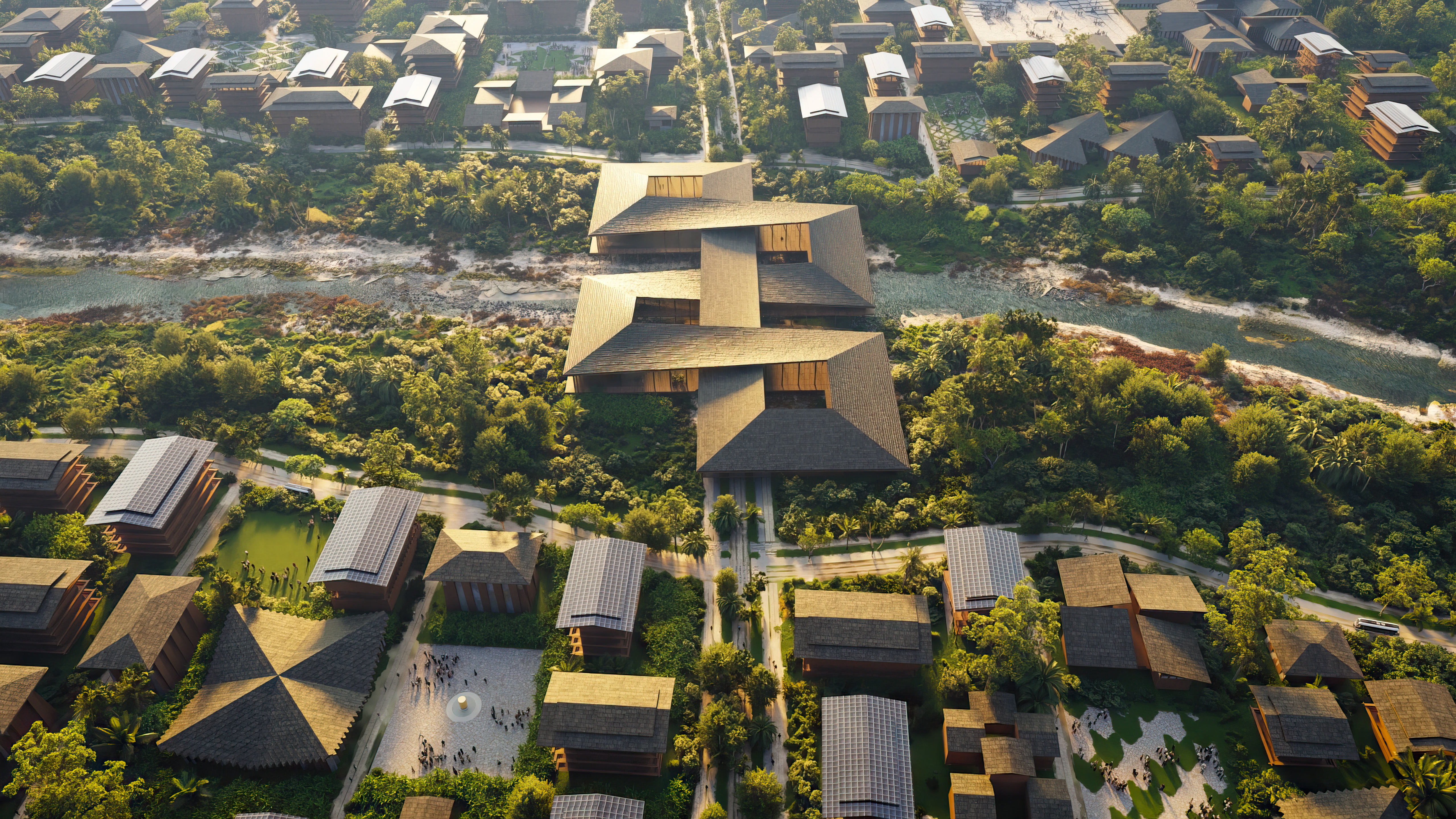
GMC’s unique “ribbon” layout connects neighborhoods with inhabitable bridges, creating micro-communities linked by shared amenities. This fosters a strong sense of belonging and encourages interaction among residents. Public spaces are designed to be interactive and inclusive, supporting cultural exchange and lifelong learning.
6. Holistic Healthcare
The city envisions integrating Eastern and Western medicine to provide holistic healthcare. Facilities will focus not only on physical health but also on mental and spiritual well-being, reflecting Bhutan’s comprehensive approach to health.
If every city and local government in the world considered at least some of those principles in their decision making, our cities would be much nicer places to live in. Ideas like Community-Centered Urban Design are not too different from what 15-Minute Cities are trying to achieve. Retrofitting our cities so that we all have access to shops and amenities, that fulfill our basic needs, within our local communities.
“Gelephu Mindfulness City layout connects neighborhoods with inhabitable bridges, creating micro-communities linked by shared amenities. This fosters a strong sense of belonging and encourages interaction among residents. Public spaces are designed to be interactive and inclusive, supporting cultural exchange and lifelong learning.”


What is potentially an issue with Gelephu Mindfulness City is the fact it has been initiated by a King, and therefore it is hard to know how much the people of Bhutan were consulted. Gross National Happiness, the renowned economic model from Bhutan, was developed with significant input from the Bhutanese people and reflects a deeply rooted cultural and philosophical foundation rather than being a purely top-down concept. So hopefully this was the same. Ultimately, projects that deeply and genuinely consult the people who inhabit a space or will inhabit a space have a much better chance of being a success.
As a project that signposts to a Wonderful Green Future, I do think this is noteworthy. And certainly, a lot better than most other new cities that are being developed. (Telosa – America’s $400 Billion Dystopia) I look forward to watching this project progress, and hopefully, it’s a success and inspires cities everywhere to try some of its ideas. While this project may be more HydroPunk than SolarPunk, 😏 there are a lot of ideas in it that will appeal to fans of the genre.
To find out more about those principles and other information, check out the official website here: www.gmc.bt. There are lots of really interesting ideas in the project, including a temple built into a hydroelectric dam.
This post was created in #WordPress and can be viewed in the #Fedivers at: @owgf.org@owgf.org
OWGF has a Fediverse companion profile at: https://mastodon.world/@OWGF
OWGF is also on #Pixelfed here: https://pixelfed.social/OWGF
www.owgf.org


















Leave a Reply