
I’m sure I am not the only one who’s getting a little jaded with AI-generated visions of the future. The AI style and content are starting to feel very generic. Even though there are many style and content options, they all draw on similar information in a similar way, so we are just seeing the same raw material rehashed in different ways.
Not only are we seeing the same content, but we are also witnessing a replication of the current worldview projected into the future. In many cases, we are extrapolating the mistakes we have made in urban planning today into the future. Most visions of the future appear to feature more roads, cars, skyscrapers, and what we currently perceive as “modern” looking buildings.
Most AI-generated Solar Punk images miss out on the fundamental economics and the reality of building sustainably. Many of these AI buildings of the future would require the same massive industrial complexes we have today. They would need cutting-edge materials and technology that only a few have access to. Buildings are overtly elaborate and complex and don’t allow for ad-hoc organic growth. None of this stuff can really have a place in a Solar Punk future. While we can create wonderful, elaborate public buildings, we need our urbanism and homes to be simple, modest, human-scale, and harmonized with the environment. They need to be easy to build by local craftsmen using local materials.
AI can be prompted to create these images and to envision a more realistic Solar Punk future, but few people have appeared to figure out why and how. Pascal Wicht, a strategic designer specializing in tackling complex and ill-defined problems, has, in his new series, I believe, achieved this.
Pascal describes himself as “an expert in upstream explorations, discovery research and listening to systems. I am skilled in future-oriented and critical design, harnessing weak signals of change. Advocating for active stakeholder inclusion, I am exploring, prototyping and co-creating sustainable solutions. Read his full Bio HERE
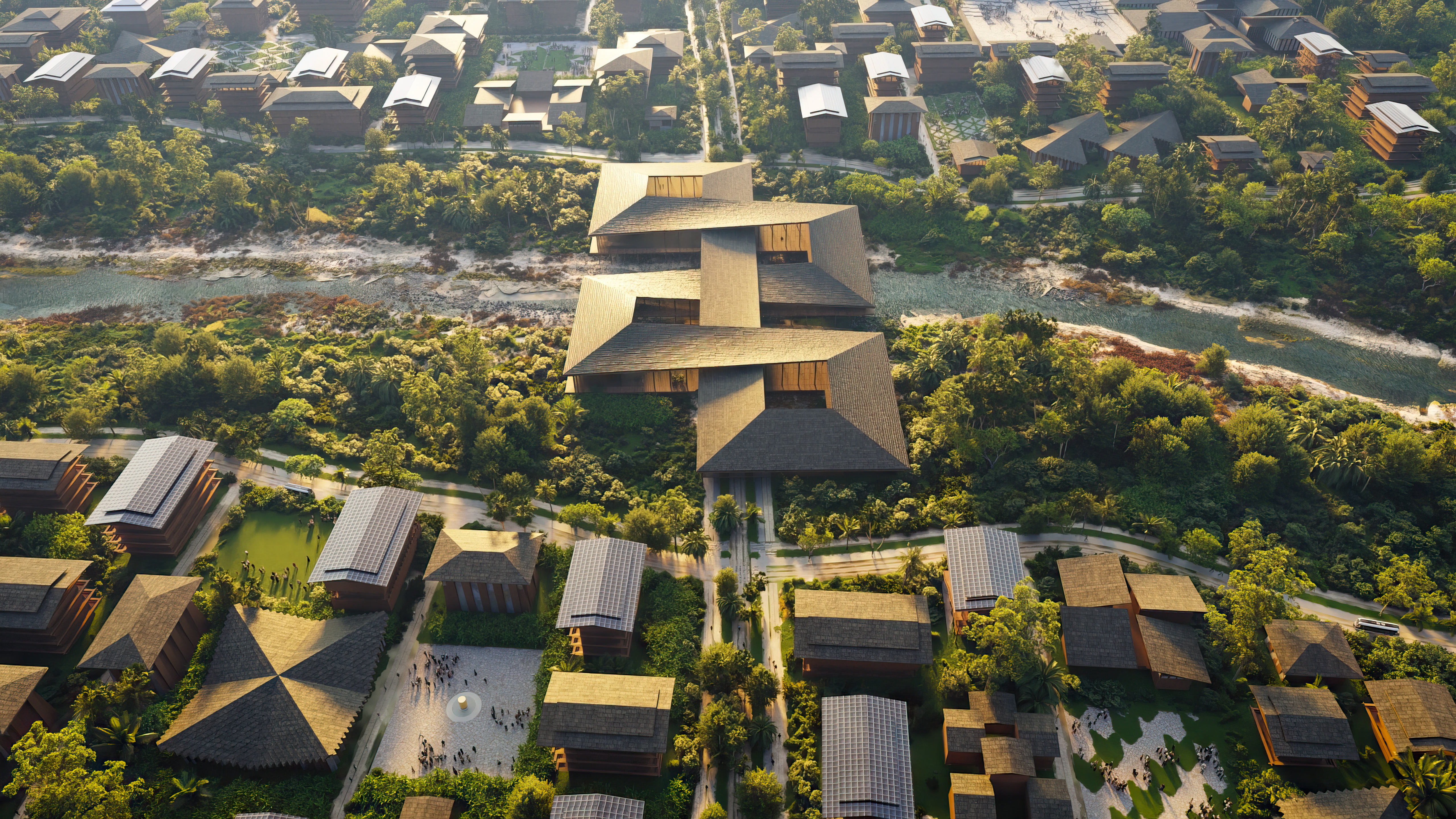
His project “Future Visualizations for Preferable Futures” captures a lot of both the realistic and desirable aspects of Solar Punk. They are not perfect images; they veer into fantasy and have the usual AI imperfections, but they are still some of the best Solar Punk AI images I have seen. I just hope our children will not be hideously deformed like this in the future! 🙂
It’s really worth reading his comments and understanding how and why he created many of the images in this series. HERE I also appreciate the work Pascal has put into looking at public transit and how rail plays an integral part in a Preferable Future.


Visions of a Solar Punk future have to be achievable through grass roots community cooperation. Using local materials and local knowledge. A Solar Punk future will mostly involve retrofitting our cities, not building everything from scratch. While most of the images don’t reflect this, we can gain inspiration from Pascal’s images—inspiration about surfaces, textures, materials, and spaces and whatever people see in these images and want to adapt to our cities.
I like the fact that many of these cities look more like holiday homes. Why wouldn’t we want every day to feel like a holiday? Why wouldn’t we build our cities like this? They feel like playful, carefree, and relaxing spaces. They don’t feel like our current cities, which simply feel like an extension of industrial complexes, with only the most wealthy able to live in lovely streets filled with trees and nature.


I also appreciate the modular, prefab design of many of the buildings, which may be the way we build everything in the future. The vertical farming integrated into the city, in such a way as it makes the city more beautiful, also intrigues me. Not like the current vertical farms, which are giant sterile boxes cut off from the city. Looking at different biomes and climates, materials, transitional architectural styles, as well as envisioning the building during construction, all make these the best Solar Punk images I’ve seen. Just without solar panels! But then again, Pascal never describes his work as Solar Punk anyway.
The Summary at the bottom of the Preferable Future Habitats page is excellent. I’m just sharing 3 points here:
Redefining lifestyle and work culture: It speculates on societal shifts such as a four-day workweek and a semi-nomadic, minimal living lifestyle, questioning current work and life paradigms.
Architectural and ecological challenges: The project also explores the architectural and ecological challenges in creating these habitats, considering weather conditions and the need for resilient infrastructure.
Visual style and challenges: The visual style avoids stereotypical futuristic tropes and focuses on a more realistic, relatable aesthetic. Challenges like incorporating vegetation, paths and managing lighting elements and moods are part of the creative process.
The full gallery of images is HERE
And if for some reason you are not inspired by all that, some of his other galleries like “Six Alpha” are excellent. As a fan of Wabi Sabi, Japanese Aesthetics, and Zen Buddhism, I loved this gallery too. HERE


Note:
This post was created in #WordPress and can be viewed in the #Fedivers at: @owgf.org@owgf.org
OWGF has a Fediverse companion profile at: https://mastodon.world/@OWGF
OWGF is also on #Pixelfed here: https://pixelfed.social/OWGFhttps://pixelfed.social/OWGF





Leave a Reply to GIMBYism – Greenery In My Back Yard (please) – Our Wonderful Green FutureCancel reply